



Archives
-
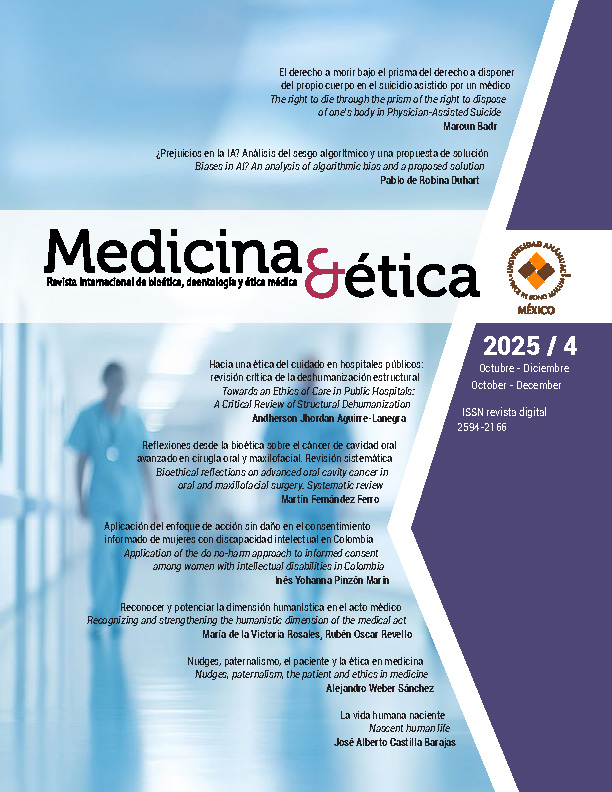
Vol. 36 Núm.4 (2025): Medicina y Ética
Vol. 36 No. 4 (2025)This final edition of the year brings together a set of contributions that, from diverse angles, underscore the pressing need to reclaim the humanistic dimension of medical practice in the face of today’s bioethical challenges. The articles explore issues such as the legal and ethical debate over the “right to die” in France, the discriminatory risks posed by algorithmic bias in artificial intelligence, and the dangers of dehumanization linked to rapid technological advances in healthcare. They also reflect on the primacy of human dignity in caring for vulnerable patients, the value of incorporating the humanities into medical education, and the ethical tensions created by behavioral tools such as nudges, which challenge the balance between autonomy and beneficence.
In addition, the issue offers an examination of oral cancer, highlighting both its biomedical and social implications, with a strong emphasis on early detection and compassionate support. A review of the volume La vida humana naciente, edited by Justo Aznar, provides an interdisciplinary perspective that affirms the dignity of life from conception, addressing threats posed by emergency contraception, assisted reproduction, and embryo experimentation. Collectively, these contributions call for a balance between scientific progress and a bioethics rooted in dignity, justice, solidarity, and the holistic care of the human person.
-
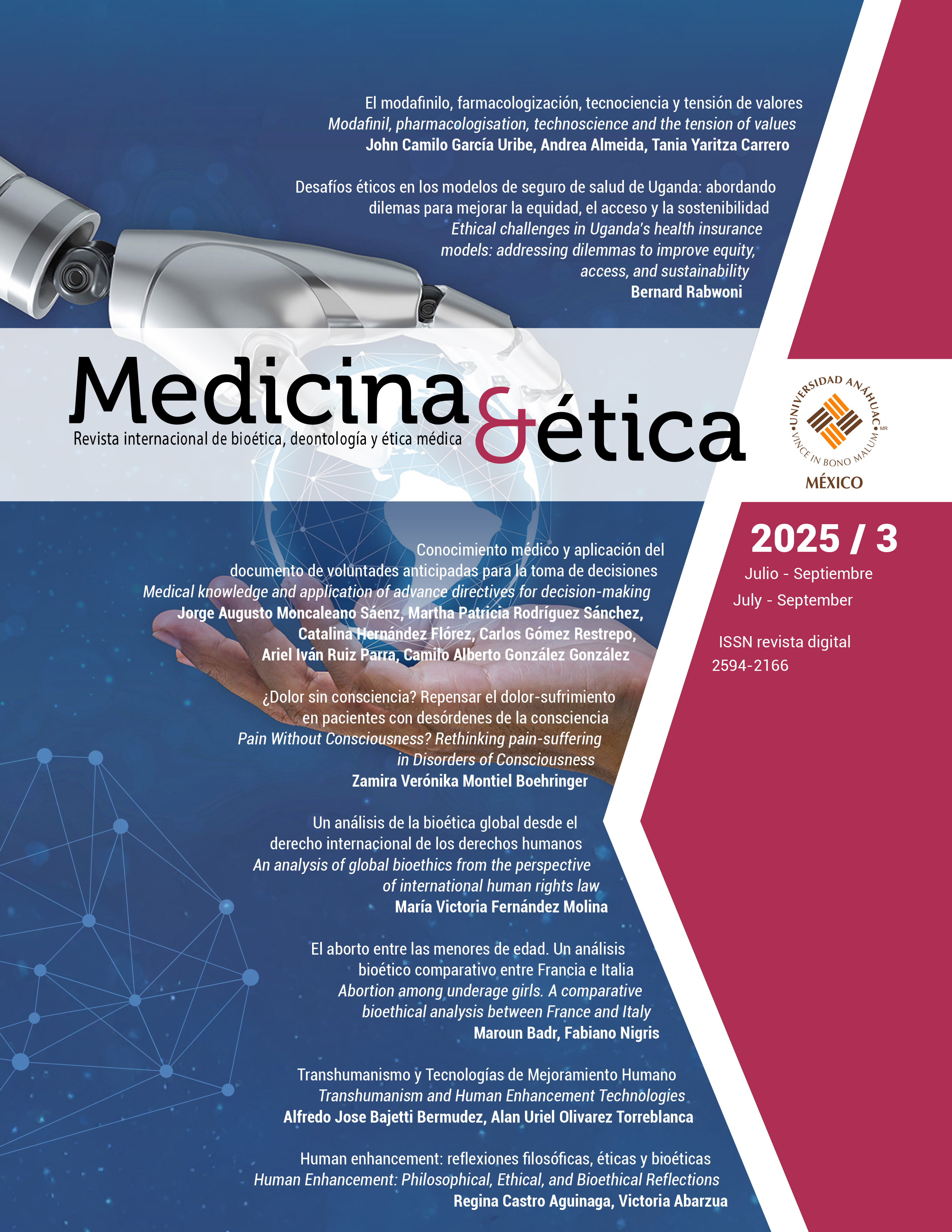
Vol.36 No.3 (2025): Medicina y Ética
Vol. 36 No. 3 (2025)Introduction
P. 806Modafinil, pharmacologization, technoscience and the tension of values
P. 835Ethical challenges in Uganda’s health insurance models:addressing dilemmas to improve equity, access and sustainability
P. 900Medical knowledge and application of advance directives for decision-making
P. 974Pain Without Consciousness? Rethinking pain-suffering in Disorders of Consciousness
P. 1042An analysis of global bioethics from the perspective of international human rights law
P. 1104Abortion among underage girls.A comparative bioethical analysis between France and Italy
P. 1160Transhumanism and Human Enhancement Technologies
P. 1190Human Enhancement: Philosophical, Ethical, and Bioethical Reflections
P. 1198Editorial policies and criteria
P. 1218 -
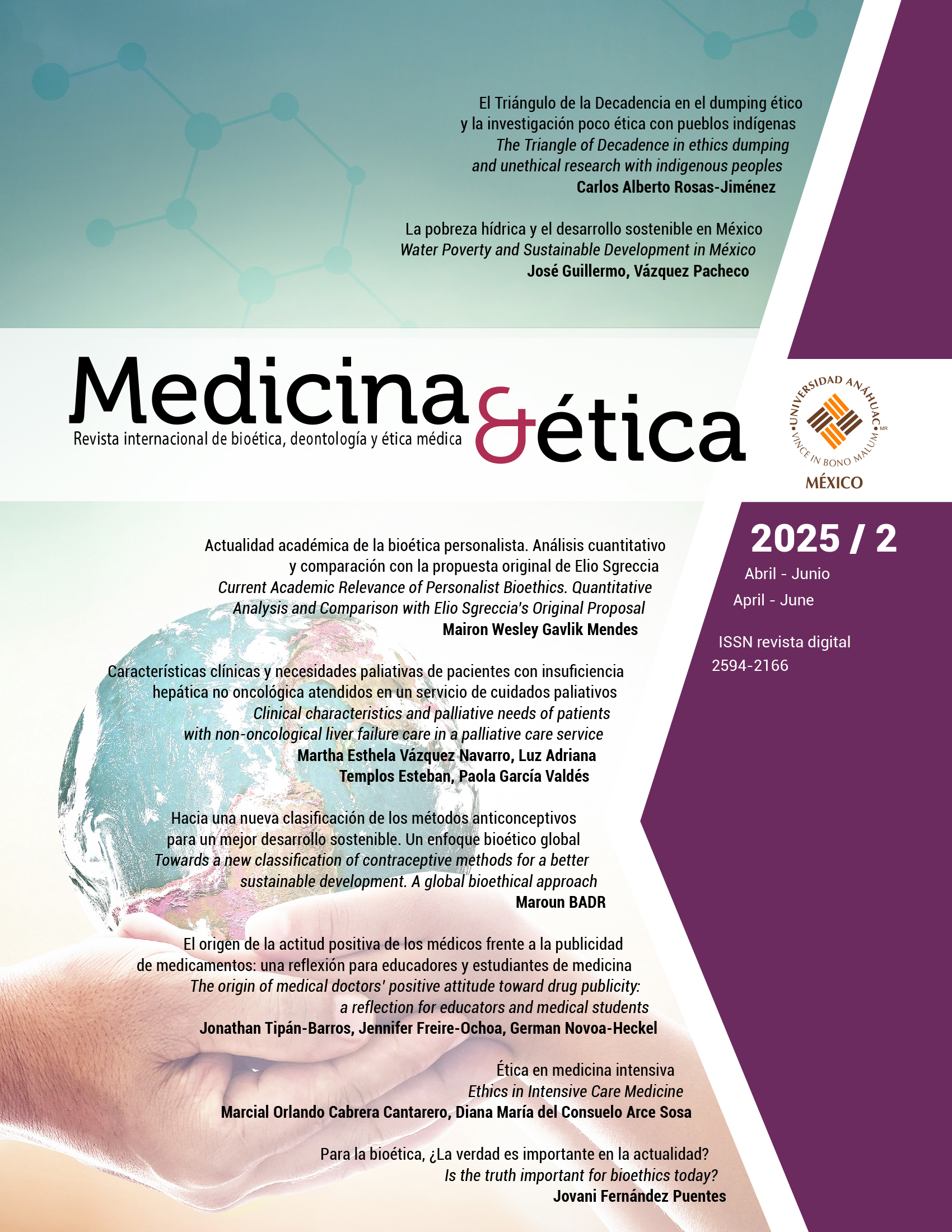
Vol. 36 Núm. 2 (2025): Medicina y Ética
Vol. 36 No. 2 (2025)Editorial policies and criteria
Introduction
The Triangle of Decadence in ethics dumping and unethical research with Indigenous peoples
Water Poverty and Sustainable Development in México
Current Academic Relevance of Personalist Bioethics. Quantitative Analysis and Comparison with Elio Sgreccia’s Original Proposal
Clinical characteristics and palliative needs of patients with non-oncological liver failure care in a palliative care service
Towards a new classification of contraceptive methods for a better sustainable development. A global bioethical approach
The origin of medical doctors’ positive attitude toward drug publicity: a reflection for educators and medical students
Ethics in Intensive Care Medicine
Is the truth important for bioethics today?
-
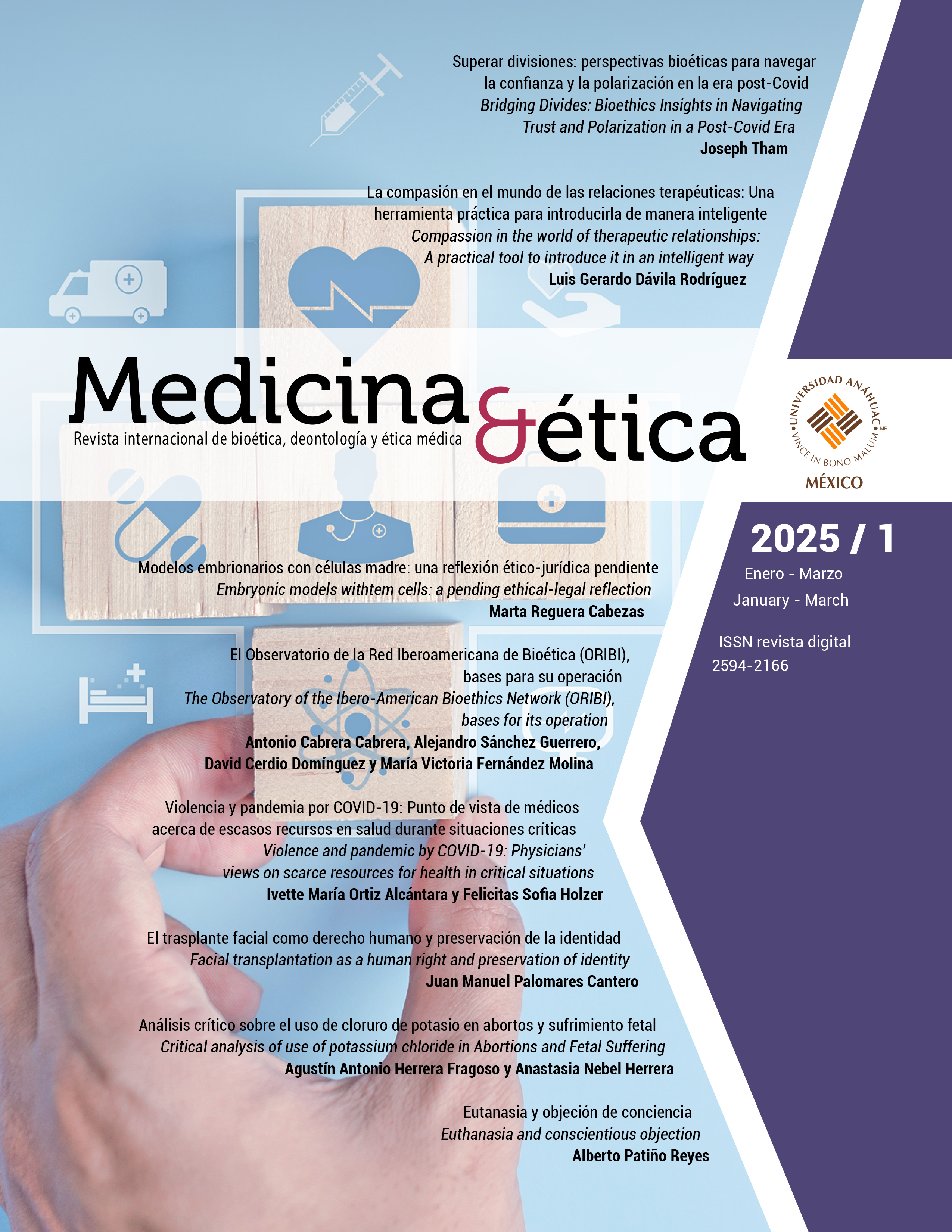
Vol. 36 Núm. 1 (2025): Medicina y Ética
Vol. 36 No. 1 (2025)Vol. 36 Núm. 1 (2025): Medicina y Ética
-
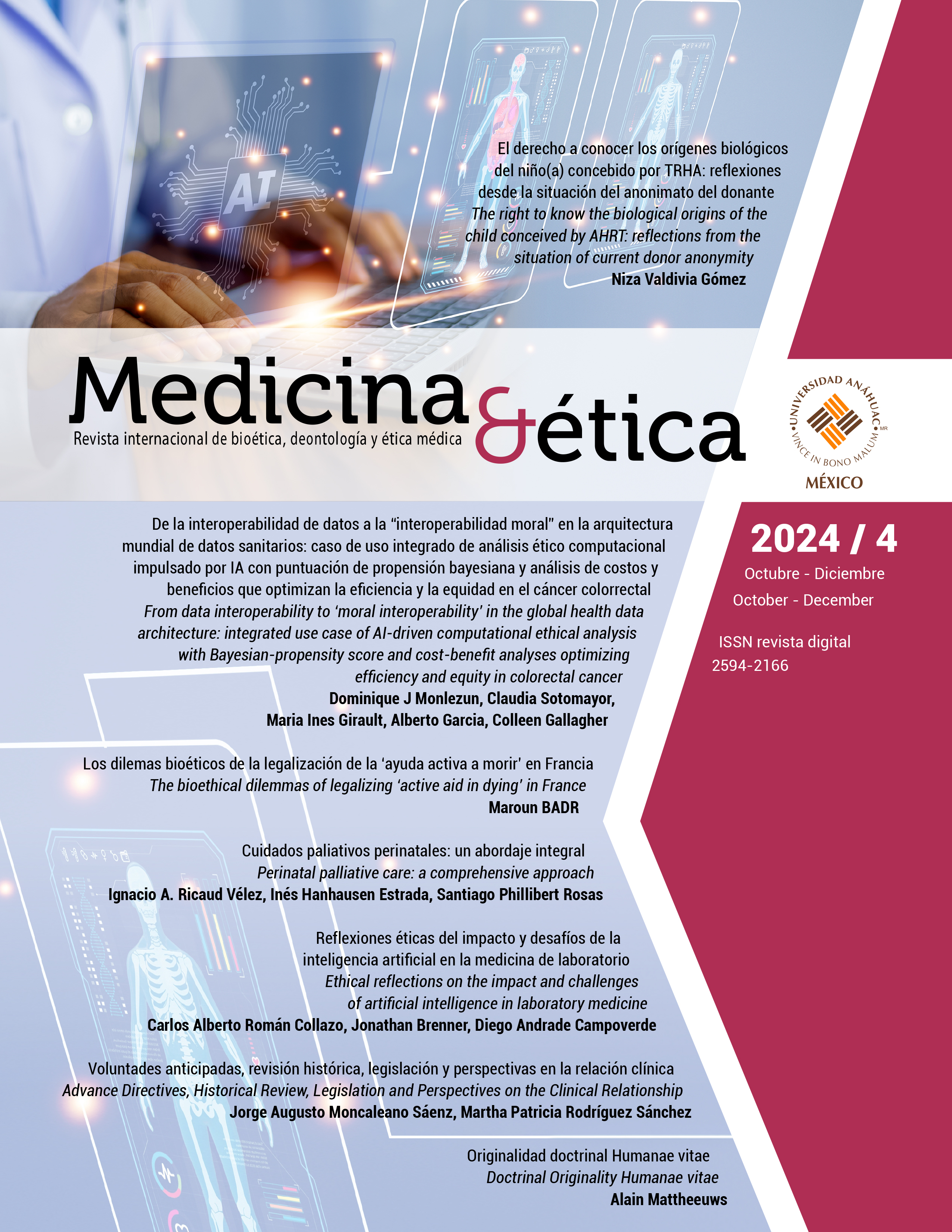
Vol. 35 Núm. 4 (2024): Medicina y Ética
Vol. 35 No. 4 (2024)Editorial
P. 949
Introduction
P. 954
Artículos
El derecho a conocer los orígenes biológicos del niño(a) concebido por TRHA: reflexiones desde la situación del anonimato del donante
P. 959
The right to know the biological origins of the child conceived by AHRT: reflections from the situation of current donor anonymity
P. 975
De la interoperabilidad de datos a la “interoperabilidad moral” en la arquitectura mundial de datos sanitarios: caso de uso integrado de análisis ético computacional impulsado por IA con puntuación de propensión bayesiana y análisis de costos y beneficios que optimizan la eficiencia y la equidad en el cáncer colorrectalP. 990
From data interoperability to ‘moral interoperability’ in the global health data architecture: integrated use case of AI-driven computational ethical analysis with Bayesian-propensity score and cost-benefit analyses optimizing efficiency and equity in colorectal cancer
P. 1024
Los dilemas bioéticos de la legalización de la ‘ayuda activa a morir’ en FranciaP. 1055
The bioethical dilemmas of legalizing ‘active aid in dying’ in France
P. 1077
Cuidados paliativos perinatales: un abordaje integralP. 1098
Perinatal palliative care: a comprehensive approach
P. 1118
Reflexiones éticas del impacto y desafíos de la inteligencia artificial en la medicina de laboratorioP. 1137
Ethical reflections on the impact and challenges of artificial intelligence in laboratory medicine
P. 1166
Voluntades anticipadas, revisión histórica, legislación y perspectivas en la relación clínicaP. 1194
Advance Directives, Historical Review, Legislation and Perspectives on the Clinical Relationship
P. 1229
Originalidad doctrinal Humanae vitaeP. 1262
Doctrinal Originality Humanae vitae
P. 1287
-
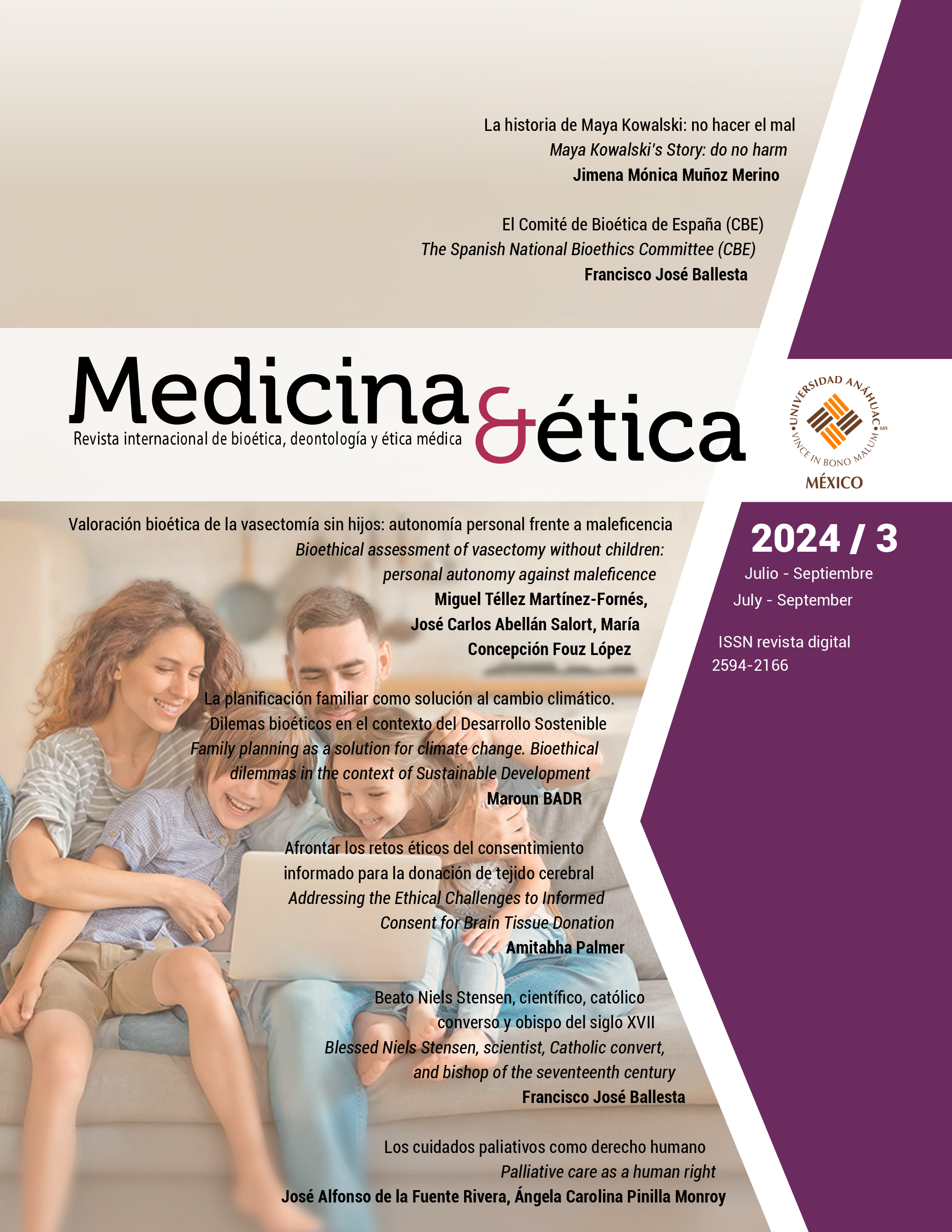
Medicina y Ética
Vol. 35 No. 3 (2024)Editorial
P. 595
Introduction
P. 599Artículos:
La historia de Maya Kowalski: no hacer el mal
P. 603
Maya Kowalski’s Story: do no harm
P. 622El Comité de Bioética de España (CBE)
P. 640
The Spanish National Bioethics Committee (CBE)
P. 677Valoración bioética de la vasectomía sin hijos: autonomía personal frente a maleficencia
P. 713
Bioethical assessment of vasectomy without children: personal autonomy against maleficence
P. 746La planificación familiar como solución al cambio climático. Dilemas bioéticos en el contexto del Desarrollo Sostenible
P. 777
Family planning as a solution for climate change. Bioethical dilemmas in the context of Sustainable Development
P. 815Afrontar los retos éticos del consentimiento informado para la donación de tejido cerebral
P. 851
Addressing the Ethical Challenges to Informed Consent for Brain Tissue Donation
P. 875Reseñas:
Beato Niels Stensen, científico, católico converso y obispo del siglo XVII
P. 896
Blessed Niels Stensen, scientist, Catholic convert and bishop of the seventeenth century
P. 900Los cuidados paliativos como derecho humano
P. 904
Palliative care as a human right
P. 910 -
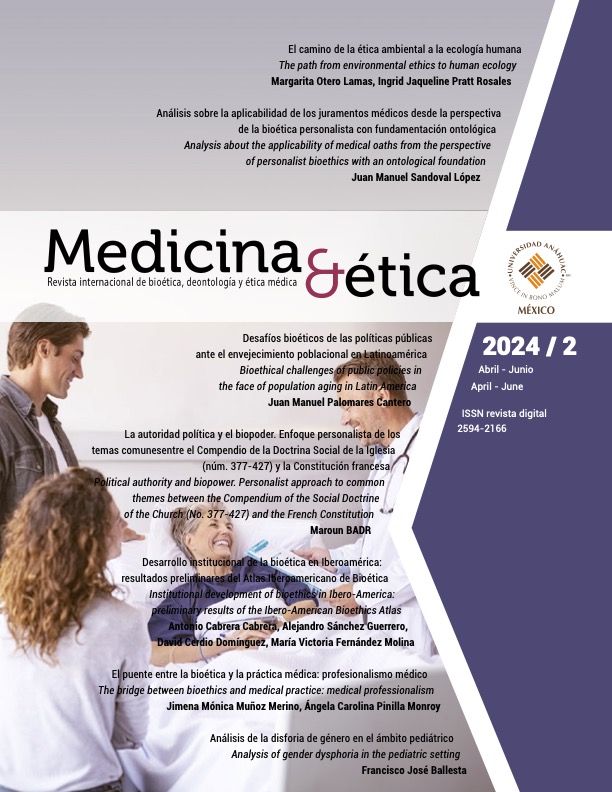
Vol. 35 No. 2 (2024)
Introduction, p. 285
Articles:
The path from environmental ethics to human ecology, p. 309
Analysis about the applicability of medical oaths from the perspective of personalist bioethics with an ontological foundation, p. 351
Bioethical challenges of public policies in the face of population aging in Latin America, p. 402
Political authority and biopower. Personalist approach to common themes between the Compendium of the Social Doctrine of the Church (No. 377-427) and the French Constitution, p. 457
Institutional development of bioethics in Ibero-America: preliminary results of the Ibero-American Bioethics Atlas, p. 511
Reviews:
The bridge between bioethics and medical practice: medical professionalism, p. 544
Analysis of gender dysphoria in the pediatric setting, p. 557 -
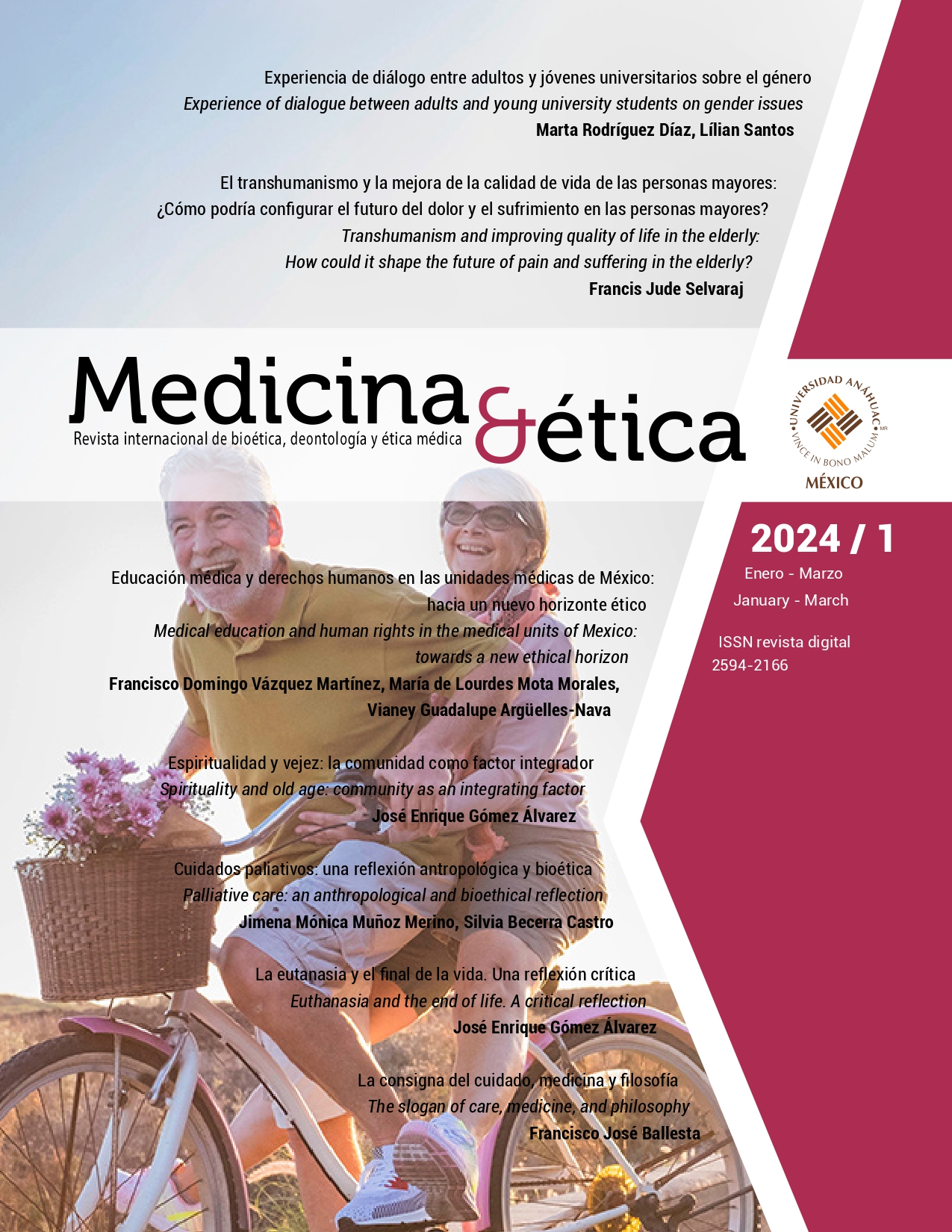
Medicina y Ética
Vol. 35 No. 1 (2024)Editorial ............................................................... 1 Introduction............................................................. 5 Articles:
Experience of dialogue between adults and young university students on gender issues ................. 35 Marta Rodríguez Díaz, Lílian Santos Transhumanism and improving quality of life in the elderly:
How could it shape the future of pain and suffering in the elderly? ................................85
Francis Jude Selvaraj
Medical education and human rights in the medical units of Mexico:
towards a new ethical horizon ....................................................................140
Francisco Domingo Vázquez Martínez, María de Lourdes Mota Morales,
Vianey Guadalupe Argüelles-Nava
Spirituality and old age: community as an integrating factor .......................189
José Enrique Gómez Álvarez
Palliative care: an anthropological and bioethical reflection ........................219
Jimena Mónica Muñoz Merino, Silvia Becerra Castro ReviewsEuthanasia and the end of life. A critical reflection ....................................................235
José Enrique Gómez Álvarez
The slogan of care, medicine, and philosophy .....................................................................244
Francisco José Ballesta -
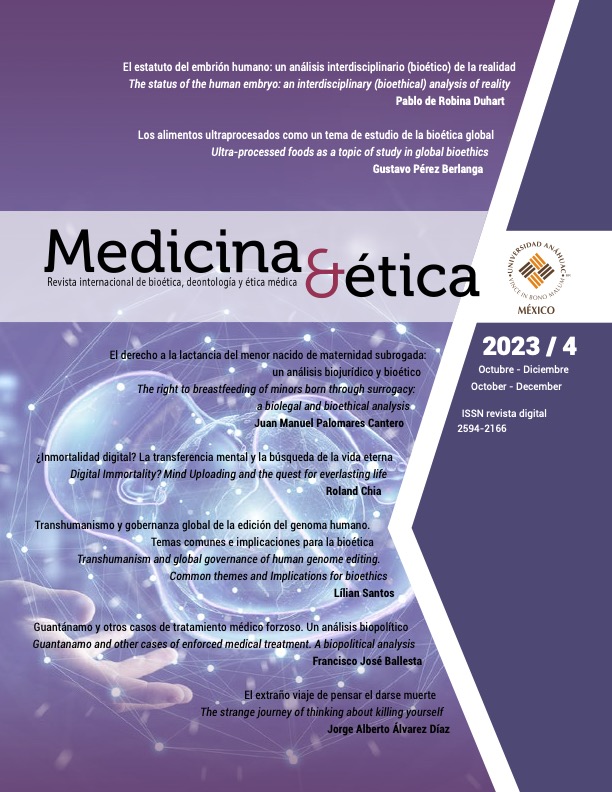
Vol. 34 No. 4 (2023)
Content
Editorial, p. 887
Articles:
The status of the human embryo: an interdisciplinary (bioethical) analysis of reality, p. 915
Ultra-processed foods as a topic of study in global bioethics, p. 968
The right to breastfeeding of minors born through surrogacy: a biolegal and bioethical analysis, p. 1018
Digital Immortality? Mind Uploading and the quest for everlasting life, p. 1063
Transhumanism and global governance of human genome editing. Common themes and Implications for bioethics, p. 1127Reviews:
Guantanamo and other cases of enforced medical treatment. A biopolitical analysis, p. 1167The strange journey of thinking about killing yourself, p. 1178
-
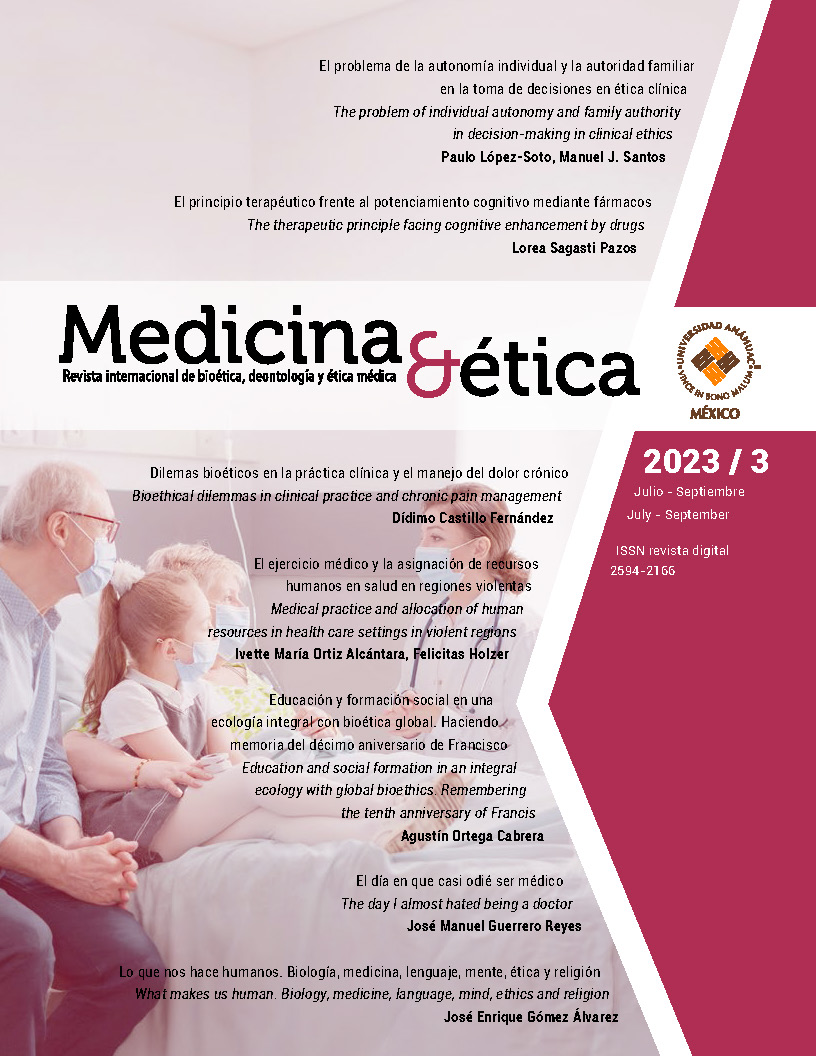
Medicina y Ética
Vol. 34 No. 3 (2023)Content
Editorial, p. 577
Articles:
The problem of individual autonomy and family authority in decision-making in clinical ethics, p. 617
The therapeutic principle facing cognitive enhancement by drugs, p. 685
Bioethical dilemmas in clinical practice and chronic pain management, p. 742
Medical practice and allocation of human resources in health care settings in violent regions, p. 784
Education and social formation in an integral ecology with global bioethics. Remembering the tenth anniversary of Francis, p. 820
Reviews:
The day I almost hated being a doctor, p. 839
What makes us human. Biology, medicine, language, mind, ethics and religion, p. 849 -
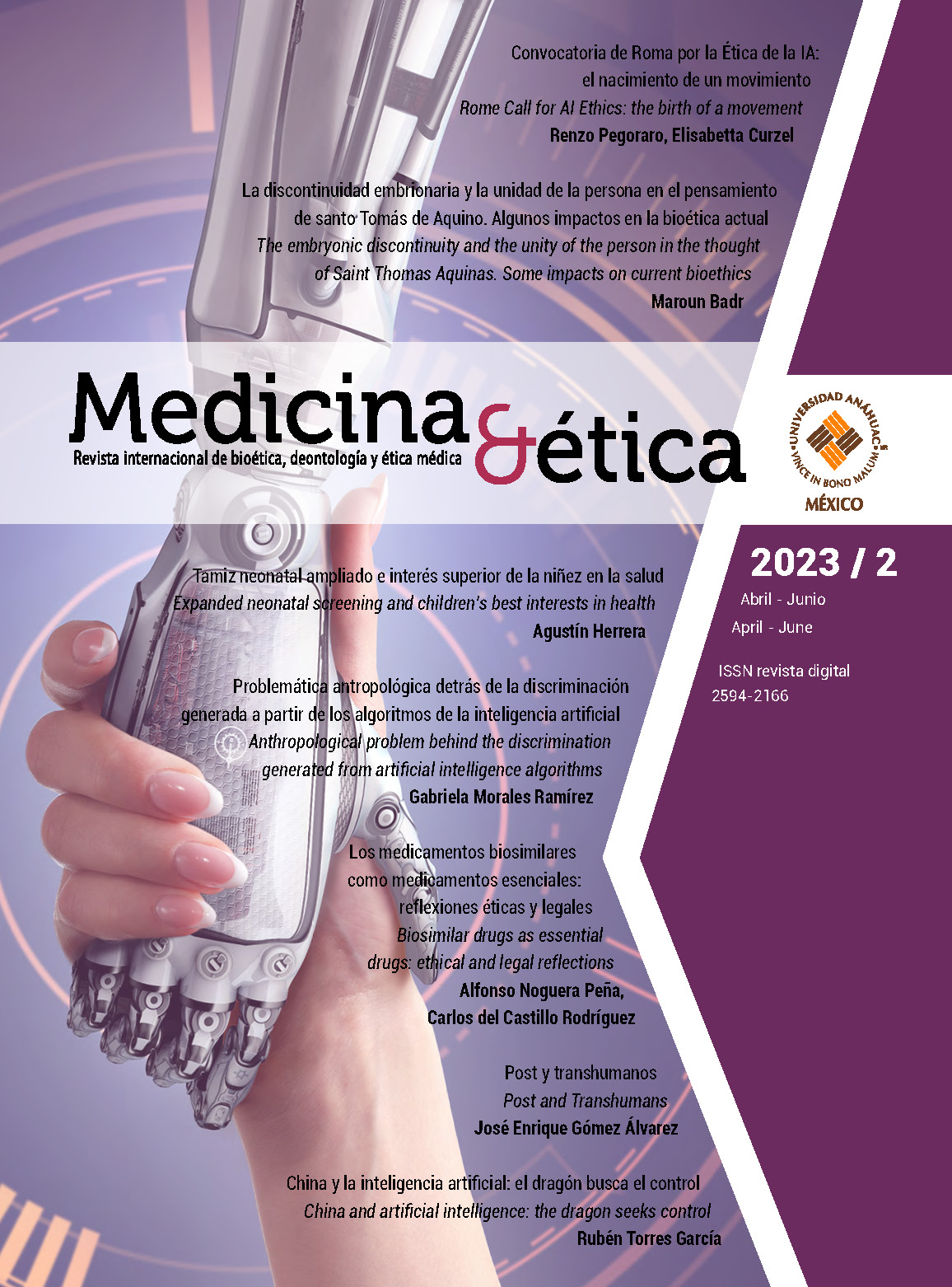
Medicina y Ética
Vol. 34 No. 2 (2023)Content
Editorial, p. 305
Introduction, p. 310
Articles:
Rome Call for AI Ethics: the birth of a movement, p. 333
The embryonic discontinuity and the unity of the person in the thought of Saint Thomas Aquinas. Some impacts on current bioethics, p. 367
Expanded neonatal screening and children’s best interests in health, p. 407
Anthropological problem behind the discrimination generated from artificial intelligence algorithms, p. 456
Biosimilar drugs as essential drugs: ethical and legal reflections, p. 502
Reviews:
Post and Transhumans, p. 526
China and artificial intelligence: the dragon seeks control, p. 538
-
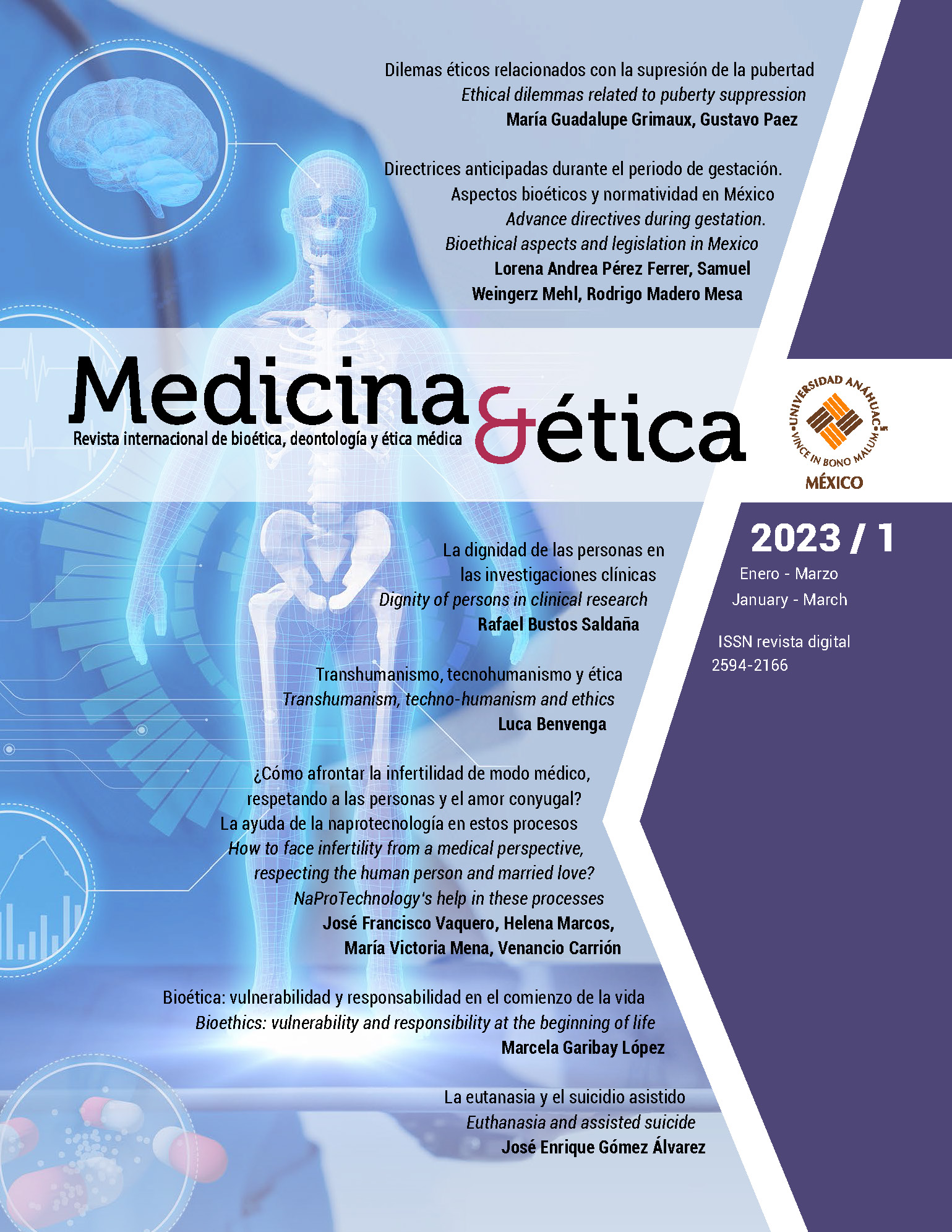
Medicina y Ética
Vol. 34 No. 1 (2023)Content
Introduction, 12
Articles:
Ethical dilemmas related to puberty suppression, p. 33
Advance directives during gestation. Bioethical aspects and legislation in Mexico, p. 87
Dignity of persons in clinical research, p. 142
Transhumanism, techno-humanism and ethics, 177
How to face infertility from a medical perspective, respecting the human person and married love? NaProTechnology´s help in these processes, p. 219
Review:
Bioethics: vulnerability and responsibility at the beginning of life, p. 246
Euthanasia and assisted suicide, p. 259
-
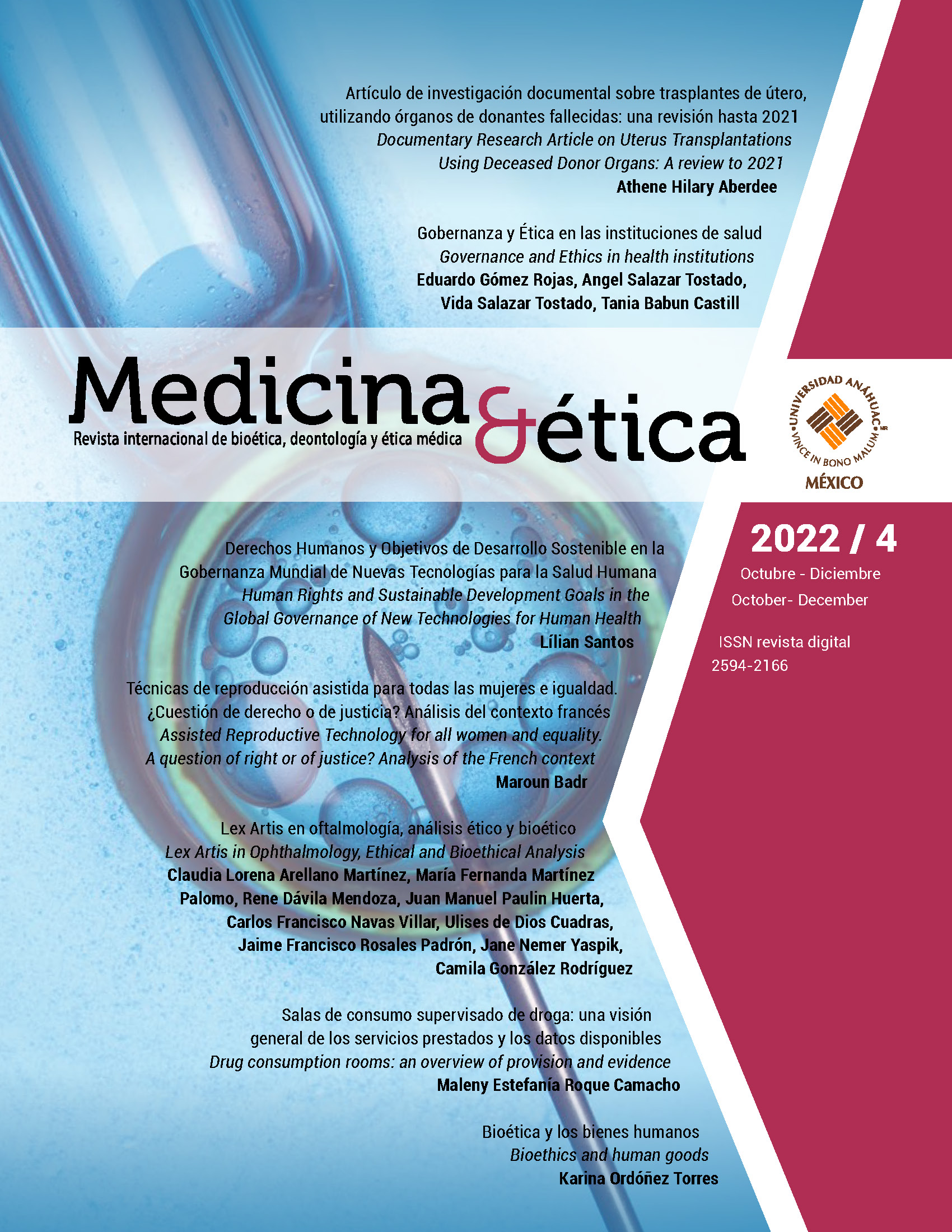
Medicina y Ética
Vol. 33 No. 4 (2022)Content
Introduction: María Elizabeth de los Ríos Uriarte, pp. 12
Articles
Ethical dilemmas related to puberty suppression: María Guadalupe Grimaux, Gustavo Paez, pp. 33
Advance directives during gestation. Bioethical aspects and legislation in Mexico: Lorena Andrea Pérez Ferrer, Samuel Weingerz Mehl, Rodrigo Madero Mesa, pp. 87
Dignity of persons in clinical research: Rafael Bustos Saldaña, pp. 142
Transhumanism, techno-humanism and ethics: Luca Benvenga, pp. 177
How to face infertility from a medical perspective, respecting the human person and married love? NaProTechnology‘s help in these processes: José Francisco Vaquero, Helena Marcos, María Victoria Mena, Venancio Carrión, pp. 219
Reviews
Bioethics: vulnerability and responsibility at the beginning of life, Marcela Garibay López, pp. 246
Euthanasia and assisted suicide: José Enrique Gómez Álvarez, pp. 259
-
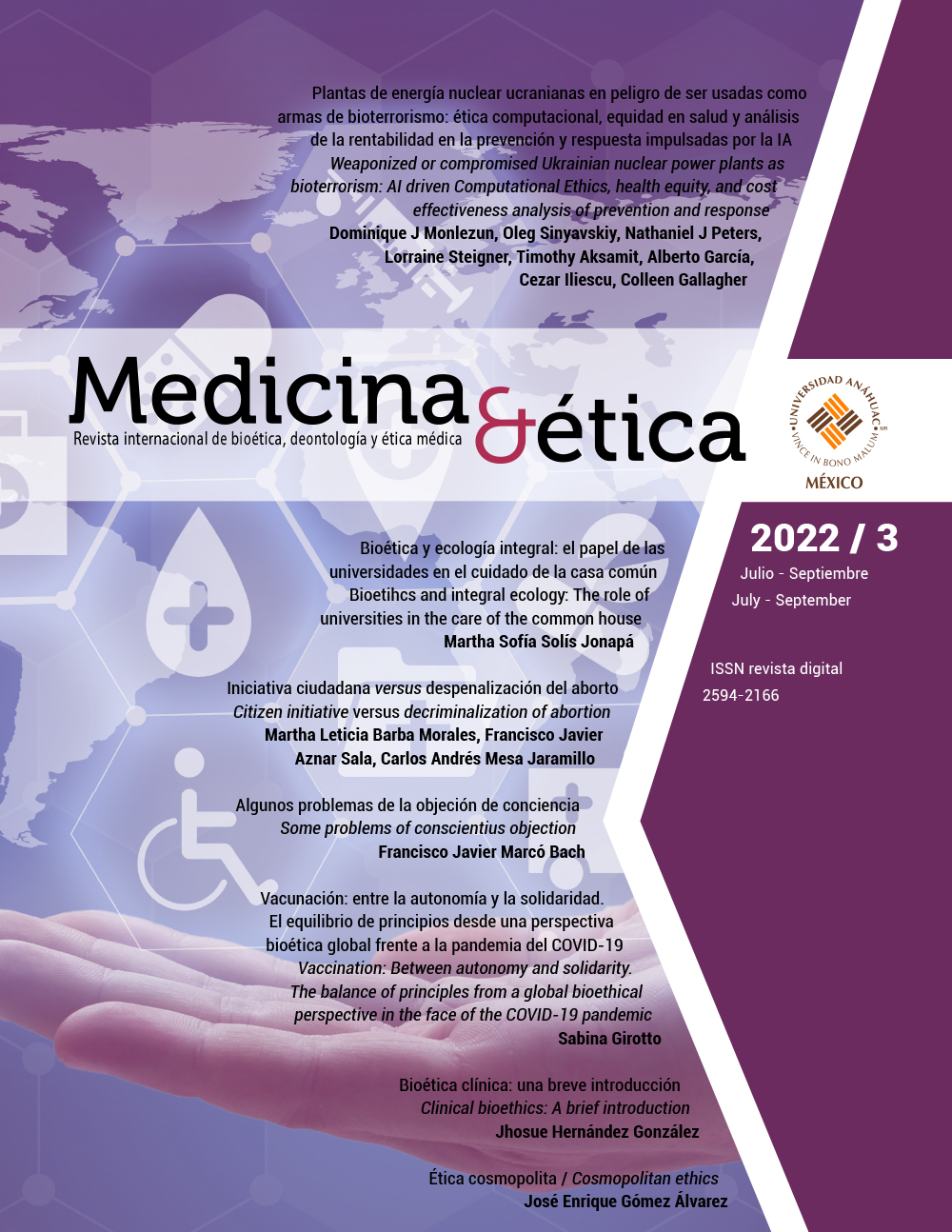
Medicina y Ética
Vol. 33 No. 3 (2022)Content
Introduction, pp. 601-606
Articles
Weaponized or compromised Ukrainian nuclear power plants as bioterrorism: AI driven Computational Ethics, health equity, and cost effectiveness analysis of prevention and response, pp. 639-666
Bioetihcs and integral ecology: The role of universities in the care of the common house, pp. 685-700
Citizen initiative versus decriminalization of abortion, pp. 737-770
Some problems of conscientious objection, pp. 805-836
Vaccination: Between autonomy and solidarity. The balance of principles from a global bioethical perspective in the face of the COVID-19 pandemic, pp. 861-882
Reviews
Clinical bioethics: A brief introduction, pp. 889-894
Cosmopolitan ethics, pp. 905-914
-
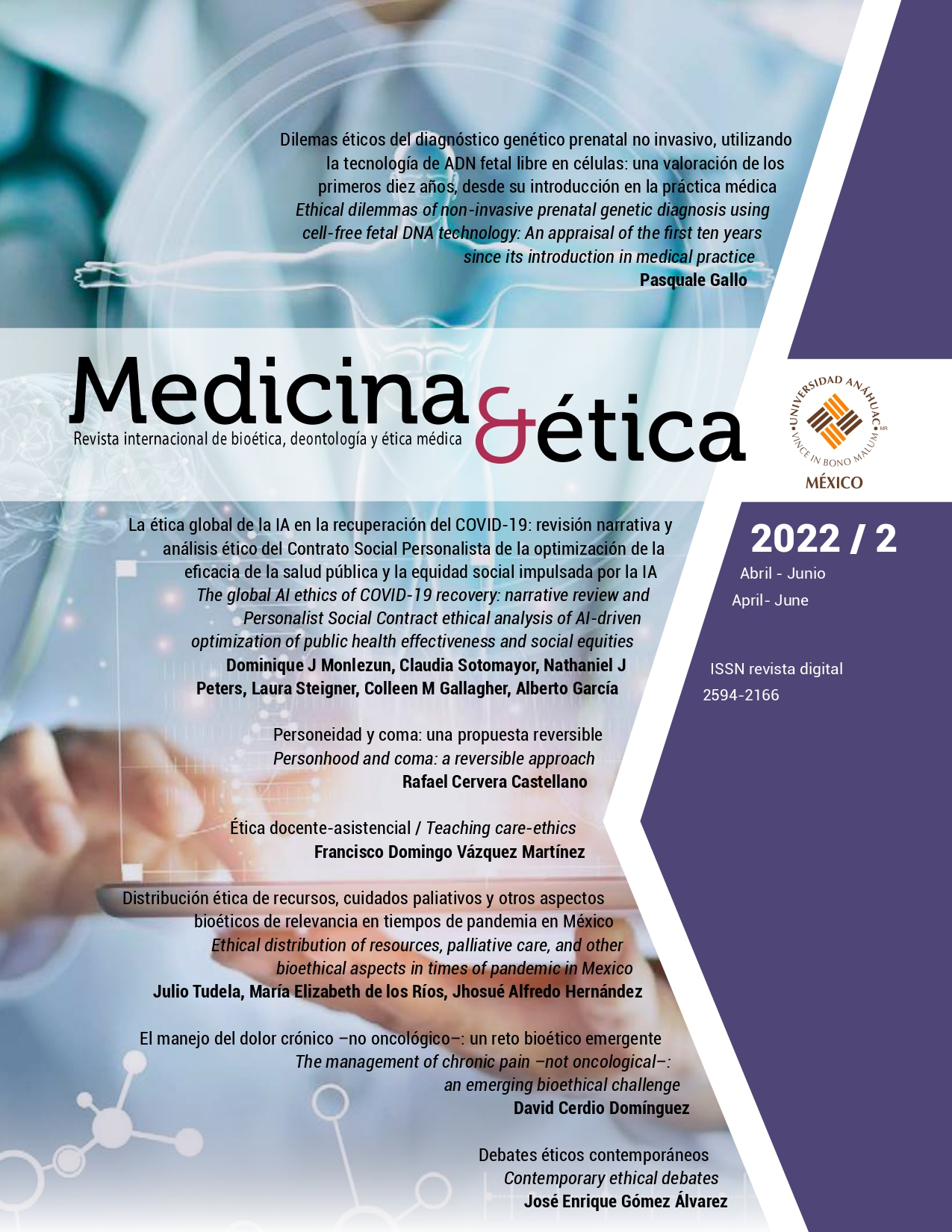
Medicina y Ética
Vol. 33 No. 2 (2022)Introduction: pp. 317-322
Articles:
Ethical dilemmas of non-invasive prenatal genetic diagnosis using cell-free fetal DNA technology: An appraisal of the first ten years since its introduction in medical practice, pp. 341-356
The global AI ethics of COVID-19 recovery: narrative review and Personalist Social Contract ethical analysis of AI-driven optimization of public health effectiveness and social equities, pp. 377-394
Personhood and coma: a reversible approach, pp. 419-440
Teaching care-ethics, pp. 457-472
Ethical distribution of resources, palliative care, and other bioethical aspects in times of pandemic in Mexico, pp. 489-504
The management of chronic pain –not oncological–: an emerging bioethical challenge, pp. 527-546
Review:
Contemporary ethical debates, pp. 555-561
-
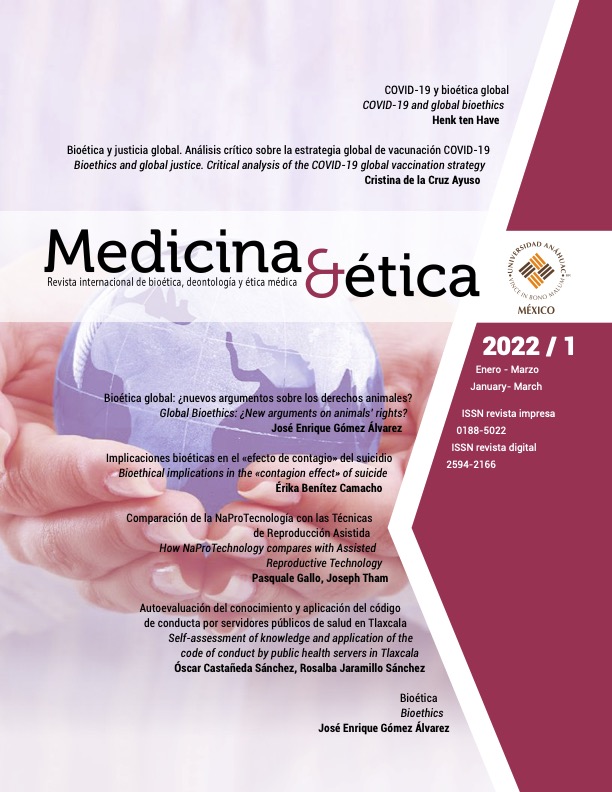
Medicina y Ética
Vol. 33 No. 1 (2022)Content
Introduction, p. 13
Articles:
COVID-19 and global bioethics, p. 53
Bioethics and global justice. Critical analysis of the COVID-19 global vaccination strategy, p. 105
Global Bioethics: ¿New arguments on animals’ rights?, p. 143
Bioethical implications in the «contagion effect» of suicide, p. 185
How NaProTechnology compares with Assisted Reproductive Technology, p. 223
Self-assessment of knowledge and application of the code of conduct by public health servers in Tlaxcala, p. 253
Review:
Bioethics, p. 273
-
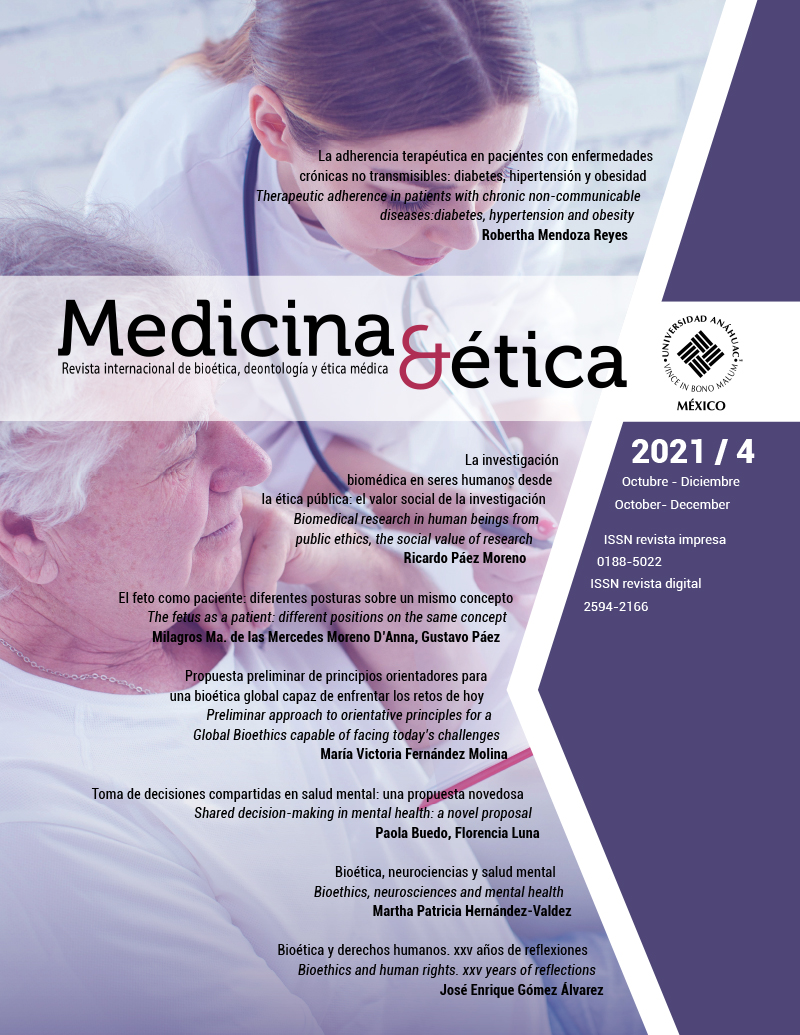
Medicina y Ética
Vol. 32 No. 4 (2021)Content
Introduction: pp. 881-889
Articles
Therapeutic adherence in patients with chronic non-communicable diseases: diabetes, hypertension and obesity, pp. 897-923
Biomedical research in human beings from public ethics: the social value of research, pp. 947-969
The fetus as a patient: different positions on the same concept, pp. 989-1009
Preliminary proposal of guiding principles for a global bioethics capable of facing today's challenges, pp. 1029-1059
Shared Decision Making in Mental Health: A Novel Proposal, pp. 1087-1111
Reviews
Bioethics, neurosciences and mental health, pp. 1135-1139
Bioethics and human rights. xxv years of reflections, pp. 1143-1149
-
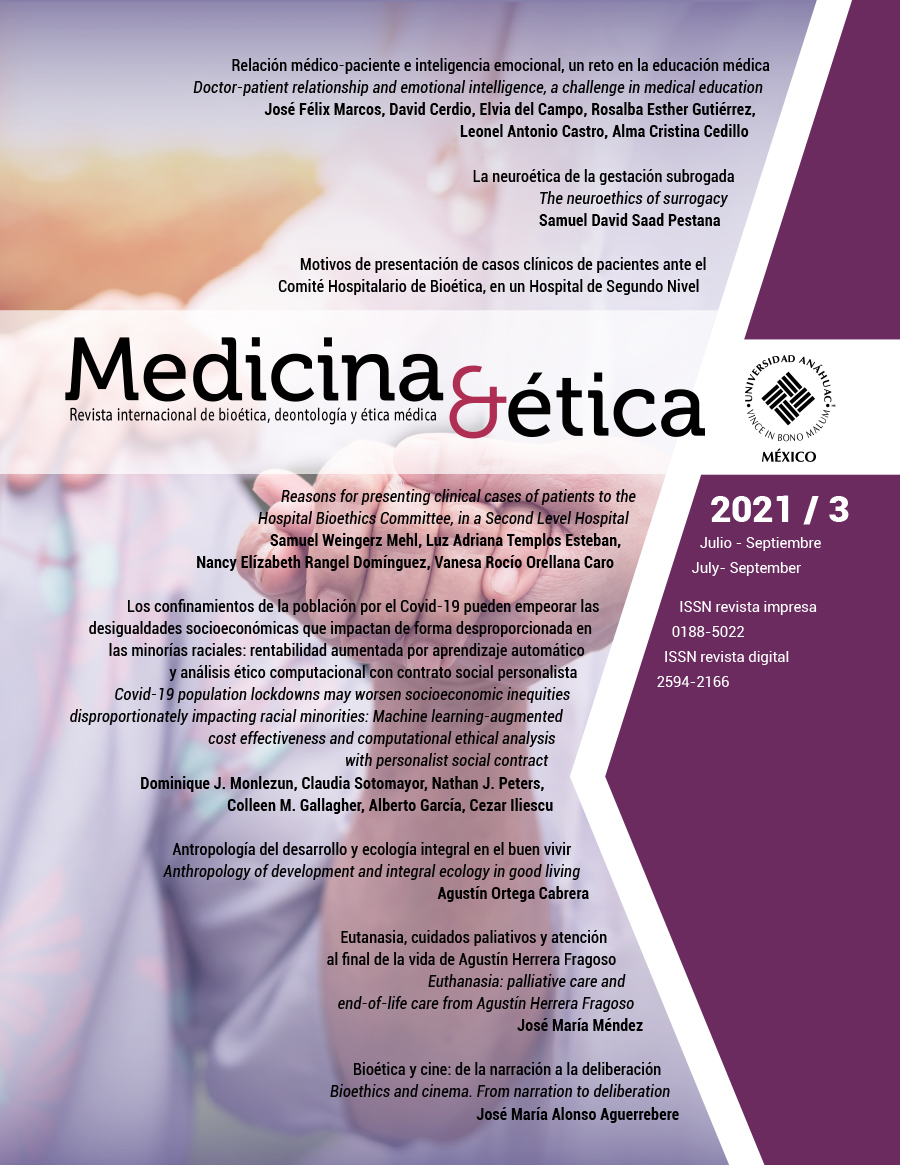
Medicina y Ética
Vol. 32 No. 3 (2021)Content
Introduction: p. 629
Articles
Doctor-patient relationship and emotional intelligence, a challenge in medical education, p. 651
The neuroethics of surrogacy, p. 685
Reasons for presenting clinical cases of patients to the Hospital Bioethics Committee, in a Second Level Hospital, p. 731
Covid-19 population lockdowns may worsen socioeconomic inequities disproportionately impacting racial minorities: Machine learning-augmented cost effectiveness and computational ethical analysis with personalist social contract, p. 781
Anthropology of development and integral ecology in good living, p. 821
Overview
Bioethics and cinema. From narration to deliberation, p. 845
-
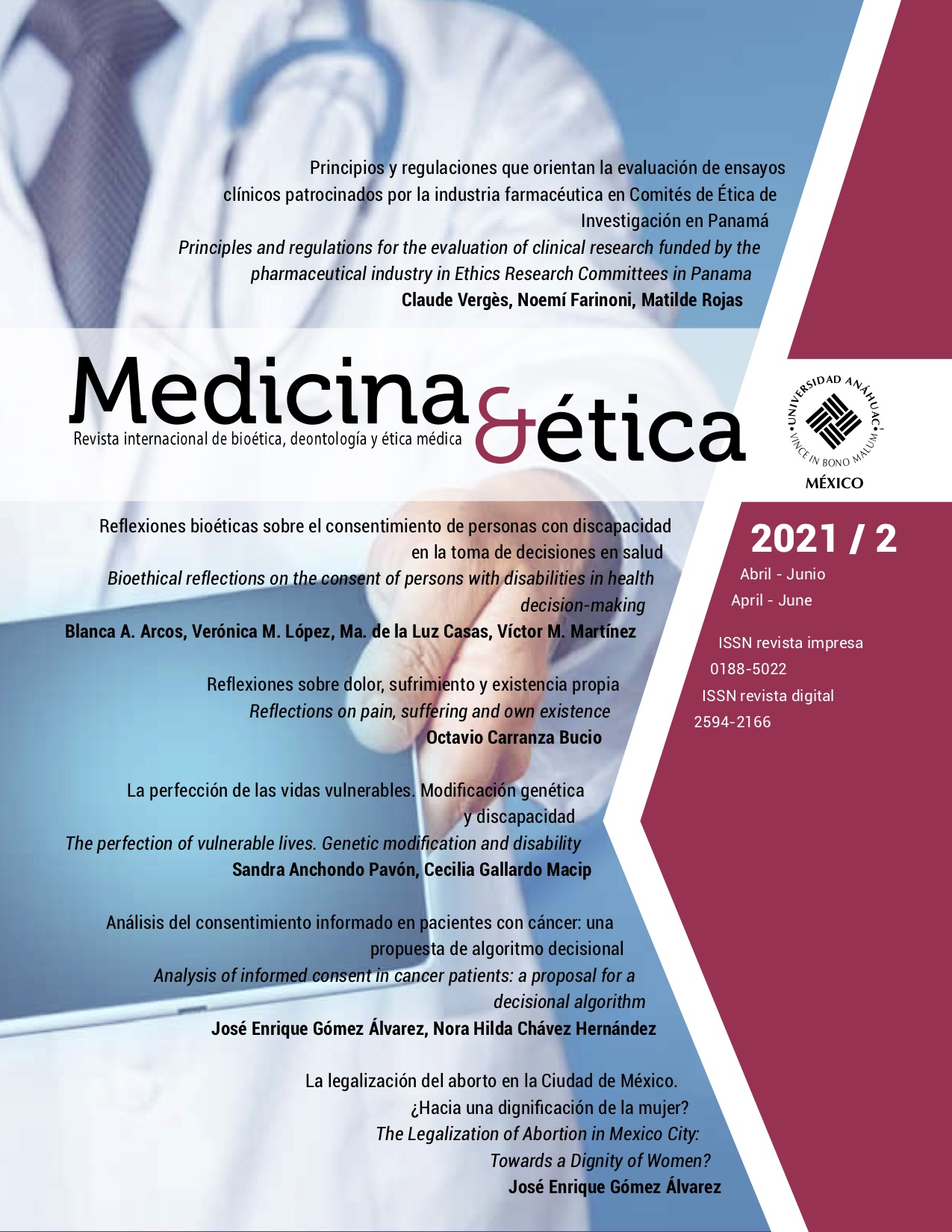
Medicina y Ética
Vol. 32 No. 2 (2021)Content
Introduction: p. 337
Articles
Principles and regulations for the evaluation of clinical research funded by the pharmaceutical industry in Ethics Research Committees in Panama: p. 375
Bioethical reflections on the consent of persons with disabilities in health decision-making: p. 425
Reflections on pain, suffering and own existence: p. 463
The perfection of vulnerable lives. Genetic modification and disability: p. 519
Analysis of informed consent in cancer patients: a proposal for a decisional algorithm: p. 569
Overview
The Legalization of Abortion in Mexico City: Towards a Dignity of Women?: p. 587
-
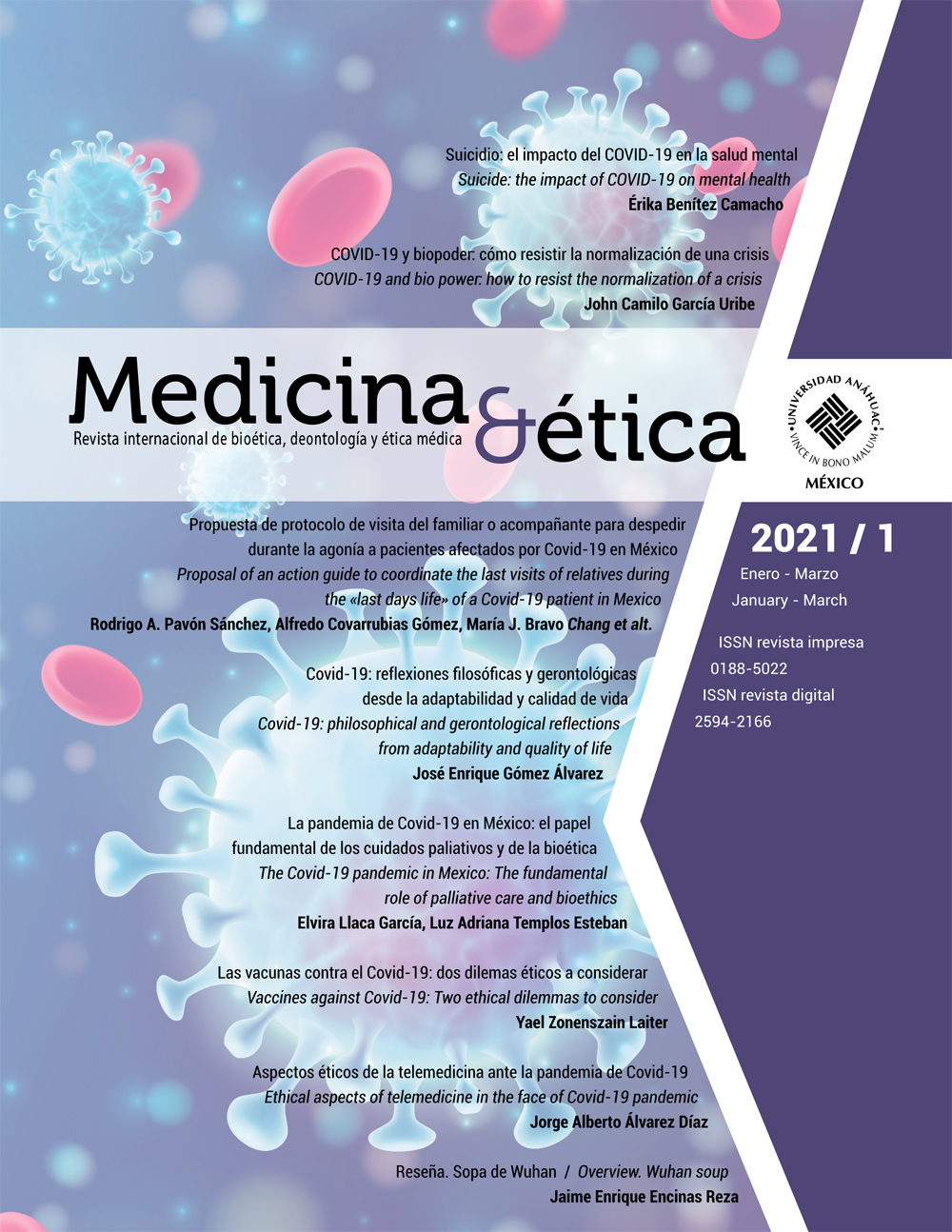
Medicina & Ética
Vol. 32 No. 1 (2021)Content
Introduction: p. 11
Articles
Suicide: the impact of Covid-19 on mental health: p. 41
Covid-19 and biopower: How to resist the normalization of crisis: p. 87
Proposal of an action guide to coordinate the last visits of relatives during the «last days life» of a Covid-19 patient in Mexico: p. 123
Covid-19: philosophical and gerontological reflections from adaptability and quality of life: p. 159
The Covid-19 pandemic in Mexico: The fundamental role of palliative care and bioethics: p. 197
Vaccines against Covid-19: Two ethical dilemmas to consider: p. 233
Ethical aspects of telemedicine in the face of Covid-19 pandemic: p. 271
Overview
Wuhan soup: p. 297
-
Medicina y Ética
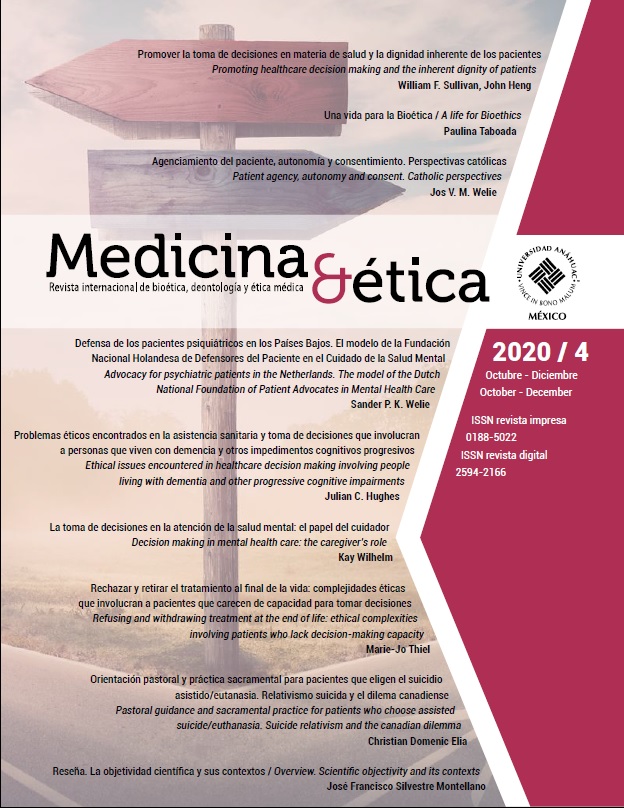
Vol. 31 No. 4 (2020)The year that we have just finished has been very difficult because of the pandemic and the confinement. For that reason, we have prepared a very special issue, which wants to celebrate first, the multiple teachings that we have acquired. Nevertheless, it is a different issue, because as you will read in the Introduction, it is about
the ethical dilemma of mental disability. These articles were written after a colloquium on this topic, held by the International Association of Catholic Bioethics (IACB) in Ottawa in June 2019.The Academic Director, Dr. William Sullivan, requested our Magazine to be able to publish the articles, which after fulfilling the requirements for peer review, could be seen together in one issue of the Journal. -
Medicina y Ética
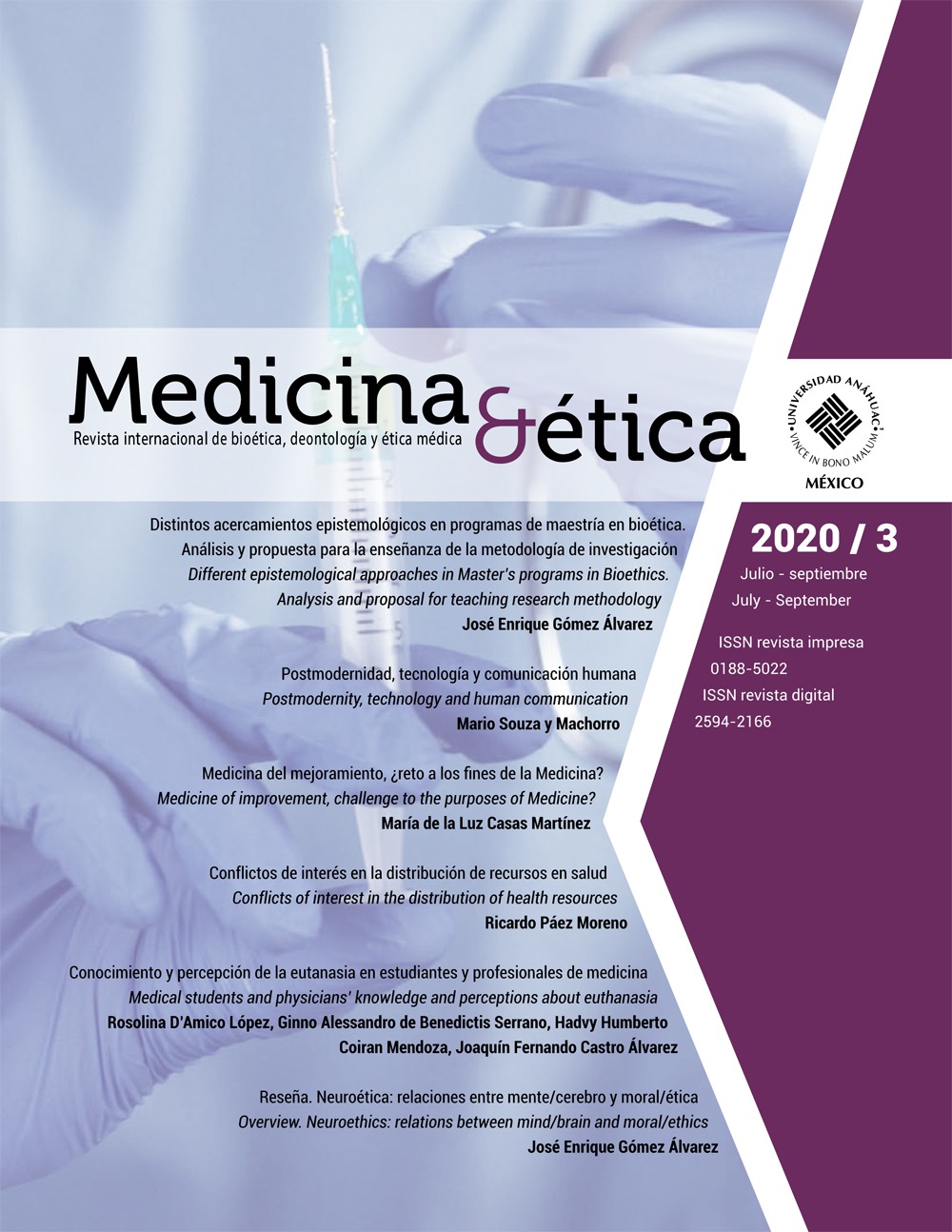
Vol. 31 No. 3 (2020)While the edition of this issue is being prepared, the first anniversary
of the death of Professor Elio Sgreccia is commemorated,
which occurred on June 5, 2019. He was the greatest exponent of
ontological personalism, applied to Bioethics, and he was the founder
of the Institute and the Bioethics Center of the University of
the Sacro Cuore in Rome, in 1984. The Medicina e Morale magazine
also founded by him depends from the above-mentioned institutions,
and to which for several years our own magazine was
linked, through an agreement to publish and translate the articles
of the Italian magazine into Spanish. Currently, both magazines
are independent, and the Mexican one has been going out uninterruptedly
four times per year, for thirty years.
Elio Sgreccia has managed to create a school of thought, not
only through the formal teaching of the Institute, as well as its
countless publications and communications on social media, but
also due to the multiple dissemination activities, and the time he
worked in the Pontifical Academy of Life before and during his
presidency. -
Medicina & Etica
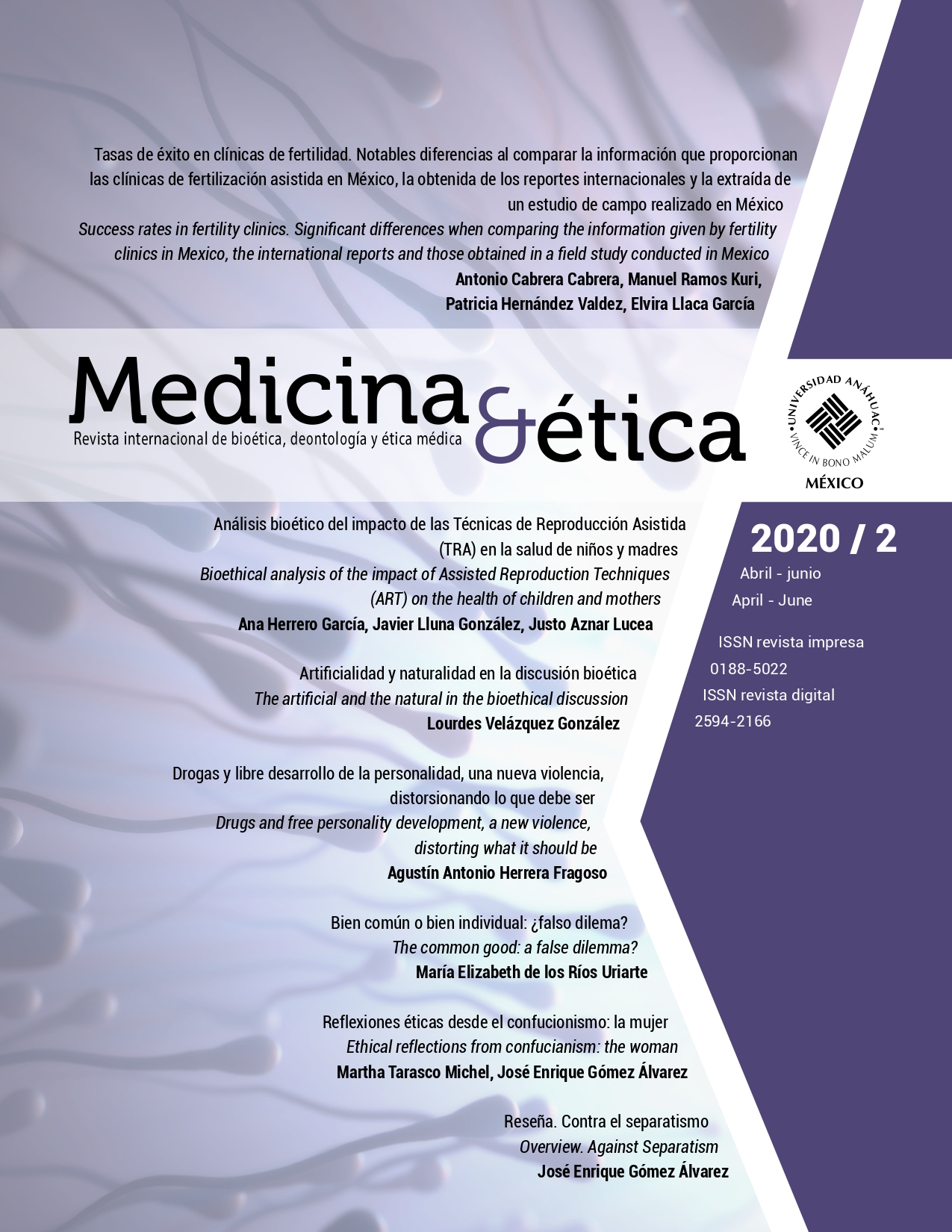
Vol. 31 No. 2 (2020)Issue number 2 of our magazine makes an emphasis on... articles on assisted reproduction techniques. The first one by Cabrera A. et al, points out through a very extensive study, which had been carried out in various Reproduction Biology Clinics in Mexico City, jointly with the international reports of the Latin American Network of Assisted Reproduction (RED LARA), that of the European Society of Human Reproduction and Embryology (ESHRE).
The second article on this topic: «Bioethical analysis of the impact of Assisted Reproduction Techniques (ART) on the health of children and mothers», is an invitation to think about the consequences of the techniques. Those techniques which since 1993 (vol 4, Num 2, pp. 47-66 by Dr. Marcó Bach), that we had already published, but that in this article, we add more data about the impact on the mother and the child.
The third article, which without being focused on assisted reproduction, is directly linked in a philosophical reflection on the artificiality presented by Velázquez L., and which focuses on the adaptation of artificiality to the ontological nature of the person. It addresses about the tension of ethicity between what is natural and what is artificial.
Another interesting article is the analysis of the decriminalization of some drugs, such as the misrepresentation of good, for the sake of autonomy, and even the call for their use, such as the development of personality. Herrera Fragoso, considers this fact as a type of violence. This violence, is assumed to destroy Bioethics, bio jury and that «laws lose their nature of being for the benefit and human development», since they must be inspired by universal values that protect the human being.
Being the universal Good, and that does not exclude the Good of anybody else, the article presented by De los Ríos, about the Common Good, justly speaks about reductionism, and the lack of understanding, of what is Good, if society is excluded, to only include the individual Good, which I consider, a welfare.
Finally, an article on Bioethics and Religions, this time on Confucianism and women. In classical Confucianism, women had a very important social role, but always subject to men (father, husband, son, brother) and by age (mother, mother-in-law).
-
Medicina y Ética
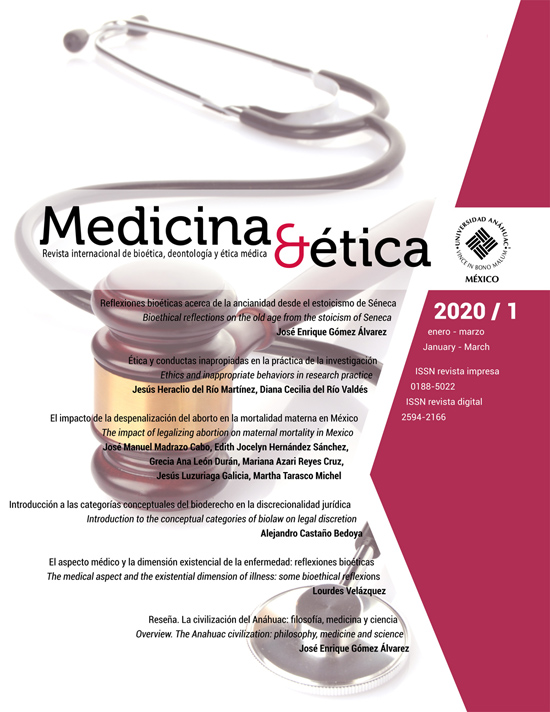
Vol. 31 No. 1 (2020)In this issue of Medicine and Ethics, various topics are addressed: research ethics, old age and stoicism, abortion, bio-law, medical and existential aspects of the bio-right, and the meaning of the disease.
The first article, «Bioethical reflections on old age from the stoicism of Seneca», by José Enrique Gómez Álvarez, addresses the ethical implications of the conception of old age in the stoicism of Seneca.
The second article, «Ethics and inappropriate behavior in research practice», by Jesús del Río Martínez and Diana del Río Valdés, analyze ethical aspects in the research process, or as they point out, the research system.
In «The Impact on the Decriminalization of Abortion in Maternal Mortality in Mexico», Madrazo et al. demonstrate that the decriminalization of abortion in 2007 in Mexico City, which among one of its justifications was to seek the reduction of maternal deaths caused by clandestine abortions, but the authors point out that he has not fulfilled that assumption.
In «Introduction to the conceptual categories of bio-law in legal discretion», by Alejandro Castaño Bedoya, the ontological and anthropological assumptions of various arguments in the law applied to bioethics are analyzed, such as physicalism or interactionist dualist theories.
Lourdes Velázquez, in «The medical aspect and the existential dimension of the disease: bioethical reflections», emphasizes the need to deepen the existential aspect of the disease as a part of the way of being and living of the human being.
The number closes with the review of the book «The Civilization of Anahuac: philosophy, medicine and science», by de José Enrique Gómez Álvarez.
-
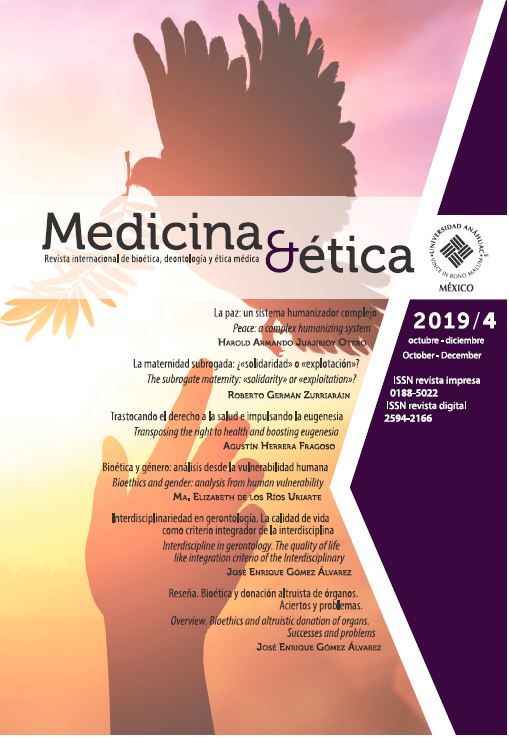
Vol. 30 No. 4 (2019)
Este número del final del año contiene artículos con enfoques múltiples y novedosos. Encabeza esta entrega el artículo sobre la paz, como sistema humanizador complejo, del Dr. Juajilbio y Otero, que aporta un estudio con una impecable metodología interdisciplinar.
Germán Zurriarán, de la Universidad de la Rioja, España, analiza los polos de la maternidad subrogada como un acto solidario y lo contrapone a la explotación de la mujer, y del hijo.
El análisis que elabora el Dr. Herrera Fragoso sobre una resolución jurídica que se encuentra en revisión, la cual impulsa a la eugenesia, se trata de un claro ejemplo de la metodología que emplea la biojurídica, esta rama de la bioética que tiene tan importante desarrollo e importancia.
La Dra. de los Ríos aborda el tema del género desde el enfoque de la vulnerabilidad, que si bien se maneja en la agenda pública, en la literatura ética no es habitual hablar de este aspecto sin victimizar a la persona. Y por último, este número concluye con un artículo sobre el cuidado del paciente geriátrico, desde el cuidado gerontológico.
Este artículo del Dr. Gómez Álvarez enfoca la calidad de vida que se busca en el cuidado de cualquier paciente crónico, como la integración de todas las interdisciplinas que forman parte de la gerontología.
1-25 of 117
Next